How to Find a Therapist Covered by Insurance in Canada (2026)
If you have workplace insurance coverage in Canada (often called "benefits"), there’s a good chance it includes mental health support. In most cases, you don’t need a formal mental health diagnosis to access this coverage. This guide will help you understand how to use your insurance to find a therapist who’s the right fit and covered by your plan.
1. Identify your insurance provider
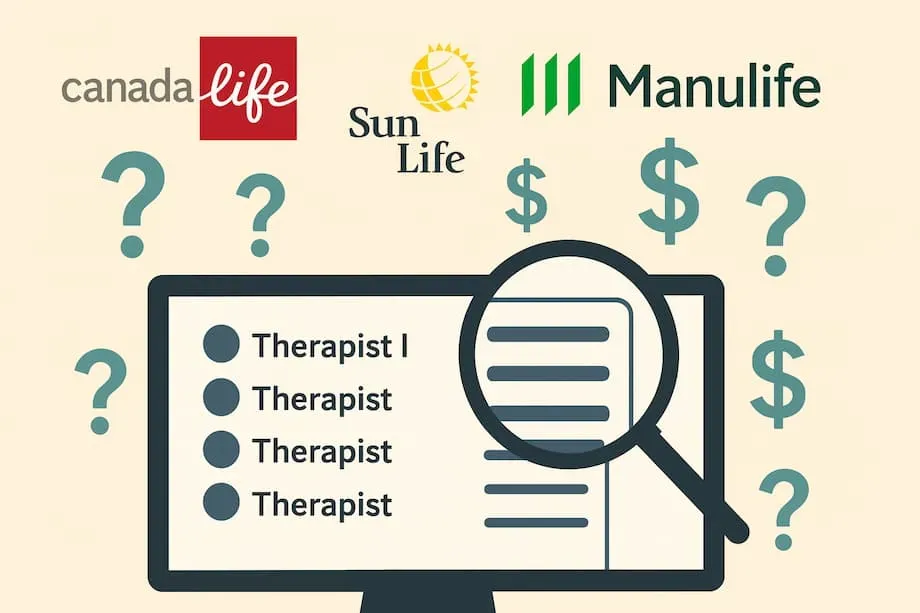
In Canada, the most common insurance providers are:
- Canada Life
- Manulife
- Sun Life
- Desjardins
- Green Shield Canada (GSC)
- Blue Cross
- Chambers of Commerce Group Insurance
- Johnston Group
- Beneva
- Industrial Alliance (iA Financial Group)
Each provider offers different plans with varying levels of care, so once you know which insurance provider you have, you need to dig into your specific plan.
2. Check your benefits booklet or insurance portal
Your insurance provider will have a benefits booklet, a PDF, or an online portal. You can ask your workplace or your plan administrator where to access this.
Once you find the details of your plan, search for "mental health", "psychotherapy," "counselling," or "psychological services."
- Therapy is often grouped under paramedical services, along with massage therapy, chiropractic, and naturopathic services.
Once you find the right section, the best way to know who and what's covered is to look for:
- The types of mental health professionals covered (e.g., psychologist, social worker, psychotherapist)
- Your annual coverage amount (e.g., $750/year). Note: this typically resets at the beginning of the calendar year. Learn more about typical therapy costs in Canada
- Any per-session caps, co-pays, or deductibles (sometimes called "reasonable and customary")
Sometimes the Insurance Provider language is blatantly confusing
If you see confusing terms like "psychological office visit," "MSW," or something like "clinical counsellor", don't be deterred. Sadly, this is your insurance company being confusing (and lazy), but you can always ask them directly. See the section below on contacting your insurance provider.
3. Identify the therapist designations that your plan covers
Insurance coverage in Canada depends on the therapist's designation or license. Here are the most commonly covered licenses and designations across Canada (learn more about therapist types):
- Registered Psychologist (may appear as C.Psych in Ontario or R.Psych in Western provinces, but also might show up as simply "Psychologist")
- Provisional Psychologist
- Registered Social Worker (RSW)
- Registered Psychotherapist (RP), and Registered Psychotherapist (Qualifying)
- Registered Clinical Counsellor (RCC)
- Canadian Certified Counsellor (CCC)
- Registered Counselling Therapist (RCT)
- Clinical Social Worker (often used interchangeably with RSW)
- MSW-holders who are also registered with a provincial college (MSW alone is not a license; it stands for Masters of Social Work)
A note on psychiatry: psychiatrists are medical doctors who specialize in mental health. Their services fall under provincial health coverage (like OHIP in Ontario) rather than extended health benefits. Accessing a psychiatrist typically requires a referral from your family doctor, and unlike other mental health professionals, they can prescribe and manage medication. If you think psychiatry might be the right support for you, that conversation starts with your health care team.
4. How to contact your insurance provider
If your benefits booklet is unclear, you can often ask your HR, Benefits, or Total Rewards team what specific therapists you get coverage for. Many companies also have employee assistance programs (EAPs) that offer additional resources and support
If reaching out internally seems daunting, you can call or email your provider directly, confidentially. Be ready with:
- Your plan number or employee ID
- The specific therapist designation and license you're looking to see if you're covered for (e.g., Canadian Certified Counsellor)
Personal note: I once called my provider because "Registered Psychotherapist" wasn't listed in my booklet. I asked if they covered that designation. They said yes and reimbursed my sessions in full. Always check.
5. Discover therapists covered by your insurance
Once you determine the designations you're covered for, check whether your insurance plan has a preferred network of providers. Some plans offer better reimbursement rates to therapists in their networks, which can reduce your out-of-pocket costs. A quick internet search on that designation and your city will also pull up additional options, and most therapist governing bodies have directories of their members on their websites.
On First Session, a Canadian platform for finding the right therapist, you can:
- Filter therapists by license: Psychologist, Registered Social Worker, Registered Psychotherapist, Canadian Certified Counsellor, etc.
- Search by focus area, therapy approach, lived experience or identity, and more
- See your therapist's price per session, their real-time availability, and book a free consultation or full session instantly
6. Choose a therapist who is the right fit
Once you have found therapists who know you have coverage for, it's important to choose a therapist who is a good fit for your care and treatment goals.
In the field of therapy, there is a term called the "therapeutic alliance" which refers to the client-therapist relationship. This is perhaps the most important factor when it comes to treatment success. In other words, who your therapist is, and how you relate to them matters!
At First Session, every therapist listed is vetted by our team, and each therapist's profile has a short introductory video to help you get a sense of who the therapist is. The videos are a great resource for gauging whether you'll connect well with a therapist before making any time investment in a free consultation or a full session.
7. Pay for therapy and get reimbursed
Some therapists offer direct billing, but not all.
While First Session does not offer direct billing, the reimbursement process is simple and fast:
- You pay for each session by credit card
- After each session, you receive a detailed receipt via email that includes:
- Therapist’s full name
- License number and professional designation
- Practice address, session date, amount paid
This is everything your insurance provider will need to process your claim, including any copay calculations if your plan covers a percentage rather than a flat rate.. Upload the receipt to your insurance portal, and your reimbursement will be on the way.
For additional assistance navigating costs, learn more about what therapy typically costs in Canada.
Find a therapist covered under your insurance
Choose the right fit for you
Trudy Wilson
Registered Social Service Worker
- Virtual sessions in AB, NT, NU
Trudy Wilson
Registered Social Service Worker
- She/her
- Offers free consultation
- $150/session
- Workplace stress, Grief and Loss, Navigating challenging relationships, Anxiety and Stress Management Skills, Attachment, Boundaries and boundary setting, Break-up recovery, Burnout, Childhood trauma, Confidence, Coping Skills, Dating challenges, Interpersonal dynamics, Life transitions, Negative thinking and ruminating, Separation and divorce, Traumatic Bereveavement, Emotional Eating, Empowerment

Cindy Reid
Therapist in Training
- Virtual sessions in ON
Cindy Reid
Therapist in Training
- She/her
- Offers free consultation
- $90/session
- BIPOC, Self-esteem, Workplace stress, Abuse (Sexual/Physical/Verbal), Boundaries and boundary setting, Burnout, Childhood trauma, Conflict resolution, Coping Skills, Dissociation, Effective communication, Emotional regulation, End of Life Support, General Mental Health, Grief and Loss, Imposter syndrome, LGBTQ2IA+, Non-Violent Communication, Perimenopause mental health support, Personal Growth, PTSD, Relationship to self and others, Self-Development, Sexuality, Trauma

Linda Ward
Canadian Certified Counsellor
- Virtual sessions in AB, BC, ON, SK, NT, YT
Linda Ward
Canadian Certified Counsellor
- Offers free consultation
- $180/session
- Attachment, Childhood trauma, Relationship to self and others, Adoption, Anxiety and Stress Management Skills, Attention-deficit/hyperactivity disorder (ADHD), Autism Spectrum Disorder (ASD), Boundaries and boundary setting, Building Meaningful Connections, Bullying, Children/Teens, Christian counselling, Complex Trauma (CPTSD), Creativity, Decision making, Depression coping skills, Divorce, Early childhood, Familial and social relationships, General Mental Health, Grief and Loss, Low Self-Esteem and Self Worth, Suicidal ideation, Trauma processing

Joyce Musekiwa
Canadian Certified Counsellor
- Virtual sessions in all provinces and territories.
Joyce Musekiwa
Canadian Certified Counsellor
- She/Her/Hers
- Offers free consultation
- $200/session
- Dealing with difficult or narcissistic personalities, Oppressive family dynamics, Trauma, Trauma processing, Attachment trauma, BIPOC, Break-up recovery, Childhood trauma, Career Stress, People pleasing, Parts Work, Somatic Therapy, Understanding & Regulating Emotions, Self-esteem, Navigating challenging relationships

Ria Wooten
Registered Psychotherapist
- Virtual sessions in ON, SK, MB, NL, NT, YT, NU
Ria Wooten
Registered Psychotherapist
- she/her
- Offers free consultation
- $170/session
- Borderline Personality Disorder, Burnout, Neurodiversity, Abuse (Sexual/Physical/Verbal), Adjusting to a diagnosis, Anger, Attachment, Befriending the Nervous System, BIPOC, Boundaries and boundary setting, Break-up recovery, Caregiver burnout, Complex Trauma (CPTSD), Cultural Challenges, Emotional regulation, Existential questions, Family Conflict, Highly Sensitive Person, Identity and Self-Exploration, Intergenerational trauma, LGBTQ2IA+, Personality & Mood Disorders, Codependency, Faith

Flip Smith
Registered Psychotherapist (Qualifying)
- Virtual sessions in all provinces and territories.
Flip Smith
Registered Psychotherapist (Qualifying)
- She/Her
- Offers free consultation
- $150/session
- Low Self-Esteem and Self Worth, Confidence, Early childhood, Anxiety, Anxiety and Stress Management Skills, Befriending the Nervous System, Boundaries and boundary setting, Body Dysmorphia, Bullying, Childhood trauma, Chronic and acute illness, Chronic Illness, Depression, Depression coping skills, Grief and Loss, Health anxiety, Identity and Self-Exploration, Imposter syndrome, Intergenerational trauma, Negative body image, Negative thinking and ruminating, Parts Work, People pleasing, Perfectionism, Trauma

Jane Whitlaw
Registered Psychotherapist (Qualifying)
- Offers in-person (Surrey, BC)
- Virtual sessions in BC, MB, AB, SK, YT, NL, NT, NU
Jane Whitlaw
Registered Psychotherapist (Qualifying)
- She/Her
- Offers free consultation
- $170/session
- Somatic Therapy, Complex Trauma (CPTSD), Attachment, Abuse (Sexual/Physical/Verbal), Addiction, Intergenerational trauma, PTSD, Work-Life Balance, Understanding & Regulating Emotions, Stress, Separation and divorce, Relationships, Nervous system regulation, Navigating challenging relationships, Mindfulness and stress reduction, Mind-body connection, Life transitions, Family Conflict, Dissociation, Depression, Childhood trauma, Boundaries and boundary setting, Anxiety and Stress Management Skills, Career guidance, Equine-Partnered Psychotherapy

Ashley Ploof-Montano
Canadian Certified Counsellor
- Virtual sessions in AB, BC, MB, NU, NT, SK
Ashley Ploof-Montano
Canadian Certified Counsellor
- she/her
- Offers free consultation
- $150/session
- Autism Spectrum Disorder (ASD), Parkinson's disease, Grief and Loss, ADHD, Adjusting to a diagnosis, Anxiety, Boundaries and boundary setting, Burnout, Coping Skills, Depression, Disability, Emotional regulation, Grief Processing, Highly Sensitive Person, Neurodivergent, Pet Loss, Self-Criticism, Self-esteem, Stress

Mandy Rai
Registered Clinical Counsellor
- Offers in-person (Richmond, BC)
- Virtual sessions in BC
Mandy Rai
Registered Clinical Counsellor
- She/her
- $165/session
- Trauma processing, Complex Trauma (CPTSD), Anxiety and Stress Management Skills, Abuse (Sexual/Physical/Verbal), ADHD, Aging, Anger, Anger Management, Assertiveness, Attachment, Attachment trauma, Attachment wounds, Betrayal Trauma, Break-up recovery, BIPOC, Anxiety, Building Meaningful Connections, Bullying, Burnout, Career Stress, Boundaries and boundary setting, Childhood trauma, Children/Teens, Blocks in Connecting with Self and Others, Caregiver burnout

Shadan Mosavat
Registered Clinical Counsellor
- Virtual sessions in BC, NU, AB, MB, NL, NT, SK, YT
Shadan Mosavat
Registered Clinical Counsellor
- She/Her
- Offers free consultation
- $180/session
- ADHD, Borderline Personality Disorder, Emotional regulation, Attachment, Boundaries and boundary setting, Childhood trauma, Couples, Dealing with difficult or narcissistic personalities, Depression, Anxiety, Trauma, Stress, Self-Regulation, Befriending the Nervous System, General Mental Health, Mindfulness, Nervous system regulation, Neurodiversity, OCD, Personal Growth, Coping Skills, Racism, Relationship to self and others, Eating disorders, Cultural Challenges

Richard Tatomir
Canadian Certified Counsellor
- Offers in-person (Langley, BC)
- Virtual sessions in all provinces and territories.
Richard Tatomir
Canadian Certified Counsellor
- He/Him
- Offers free consultation
- $200/session
- Supervising qualifying therapists, Complex Trauma (CPTSD), Psychedelic therapy, Neurodiversity, ADHD, Life transitions, End of Life Support, Cultural Challenges, Spirituality, Family Conflict, Abuse (Sexual/Physical/Verbal), Relationships, Behavioural Issues, Addiction, Anxiety and Stress Management Skills, Assertiveness, BIPOC, Befriending the Nervous System, Burnout, Caregiver burnout, Understanding & Regulating Emotions, Career Performance, Intergenerational trauma, College or University Coaching, Codependency

Areeba Farooq
Registered Psychotherapist (Qualifying)
- Virtual sessions in ON, BC, AB, MB, SK, NL, NU, NT, YT
Areeba Farooq
Registered Psychotherapist (Qualifying)
- she/her
- Offers free consultation
- $150/session
- Anxiety and Stress Management Skills, Depression, Mindfulness, Anger Management, Anxiety, Borderline Personality Disorder, Bipolar Disorder, Boundaries and boundary setting, BIPOC, Break-up recovery, Building Meaningful Connections, Burnout, Coping Skills, Confidence, Effective communication, Personal Growth, Work-Life Balance, Wellness Counselling, Understanding & Regulating Emotions, Trauma, Trauma processing, Emotional regulation, Depression coping skills, Life transitions, Mindfulness and stress reduction
Still Not Sure?
If you’ve found a therapist you like, but are unsure if you are covered, ask them:
- "Are your services reimbursable by insurance in [my province]?"
Your therapist will be familiar with insurance claim requirements and can guide you through it.
Looking for a therapist covered by your insurance? Use First Session's search tool to filter by license type and find someone who fits your needs and your benefits plan.