Is therapy tax deductible in Canada?
If you pay for therapy in Canada, you may be able to claim some of the cost on your tax return. The key issue is the therapist's professional designation and whether that profession is recognized by the CRA in the province or territory where the service was provided. For most people, therapy is claimed as a medical expense tax credit on a personal tax return.
For mental health care, the most relevant provider types usually include psychologists, social workers, psychotherapists in certain jurisdictions, and counselling therapists in certain jurisdictions. The CRA uses a province-by-province and profession-by-profession list of authorized medical practitioners for medical expense tax credit purposes.
Is therapy tax deductible in Canada?
Yes, therapy can qualify for tax relief in Canada when the service is provided by a CRA-recognized medical practitioner who is authorized to practise in the relevant province or territory. On a personal income tax return, this is generally claimed through the medical expense tax credit.
That means the practical question is simple: Was the therapy provided by a licensed professional whose designation appears on the CRA's eligible practitioner list for that jurisdiction?
Which licensed mental health professionals usually qualify?
Psychologists
Psychologists are the clearest category. The CRA's authorized practitioner table includes psychologists across all provinces and territories for medical expense tax credit purposes. If a client sees a properly licensed psychologist, the path to claiming the expense is usually straightforward.
Registered Social Workers
Social workers are recognized by the CRA in many provinces. The CRA table includes social workers in Alberta, British Columbia, Manitoba, New Brunswick, Newfoundland and Labrador, Nova Scotia, Ontario, Prince Edward Island, Quebec, and Saskatchewan. Eligibility therefore depends in part on where the service was provided.
Registered Psychotherapists
Psychotherapy is recognized in a narrower set of jurisdictions for income tax purposes. On the CRA table, psychotherapist-related categories appear in Ontario and Quebec. For someone seeing a registered psychotherapist, the province matters a great deal. Registered Psychotherapist (Qualifying) will be covered the same way as Registered Psychotherapists.
Counselling therapists
The CRA separately lists counselling therapists in New Brunswick, Nova Scotia, and Prince Edward Island. For clients in those provinces, counselling therapy may fit within the CRA rules when the provider is properly authorized.
What about designations like Registered Therapeutic Counsellor, Registered Professional Counsellor, or Canadian Certified Counsellor?
This is where precision matters. On the CRA's authorized medical practitioner page, the titles Registered Therapeutic Counsellor, Registered Professional Counsellor, and Canadian Certified Counsellor do not appear by name on the current list.
For a client, that usually means the claim rises or falls on whether the provider also practises under a CRA-recognized regulated category in that province or territory. A therapist may offer valuable care and still fall outside the CRA categories used for the medical expense tax credit.
A practical summary looks like this:
Therapy from a licensed psychologist is usually claimable.Therapy from a registered social worker is often claimable, depending on province.Therapy from a registered psychotherapist or counselling therapist depends heavily on province.Therapy from someone whose designation is only RTC, RPC, or CCC may require extra caution, because those titles are not listed by name on the CRA page.
A useful clarification on GST/HST
There is a separate CRA rule for GST/HST. As of June 20, 2024, certain psychotherapy and counselling therapy services became exempt from GST/HST. That rule affects sales tax. The medical expense tax credit is a separate income tax rule with its own practitioner list and eligibility criteria.
This distinction is worth making clearly in the article because many readers will assume that GST/HST treatment and income tax treatment always move together. They do not follow the same legal test.
How do you actually claim therapy on your taxes?
Eligible therapy expenses are claimed through the medical expense tax credit on a personal tax return. For 2025 returns, the CRA says you can claim eligible medical expenses for yourself, your spouse or common-law partner, and children under 18 on line 33099. Certain other dependants may be claimed on line 33199. The CRA also allows you to use any 12-month period ending in the tax year, as long as those expenses were not claimed before.
The CRA also notes that spouses or common-law partners may want to compare who should make the claim, since the threshold is tied to net income and the lower-income spouse may get a better result.
What you'll need at tax time
Start by adding up all eligible medical expenses for the claim period. Include therapy receipts only when the therapist's designation qualifies under the CRA rules for that province or territory. Then enter the total on the appropriate medical expense line of the return.
The value of the claim depends on your income and your total eligible medical expenses. The CRA says you subtract the lesser of 3% of your net income or the annual threshold amount, which is $2,834 for 2025, from your total eligible medical expenses. The remaining amount feeds into the federal medical expense tax credit. The CRA describes the credit as a non-refundable tax credit, and the federal rate is tied to the lowest personal income tax rate.
1. Receipts
Yes, you should keep receipts. The CRA says medical expenses should be supported by proper receipts and related documents.
2. Specific details on the receipts
The CRA says receipts should be dated, marked paid, and clearly show the reason for the payment, the name of the patient, and where applicable the medical practitioner who prescribed or provided the service. For therapy, a strong receipt usually includes the client's name, therapist's name, designation, date of service or payment, amount paid, and a brief description of the service.
3. Proof that the amount was actually paid by you
The CRA says you cannot include medical expenses for which you were reimbursed or will be reimbursed. That matters for anyone using extended health benefits through work or a private insurer. Only the unreimbursed portion is generally relevant to the medical expense claim.
4. Record retention
If you file electronically, you usually keep the documents rather than submitting them up front. The CRA may ask to review receipts and supporting documents later.
What could this look like in real life?
Let's use a simple example.
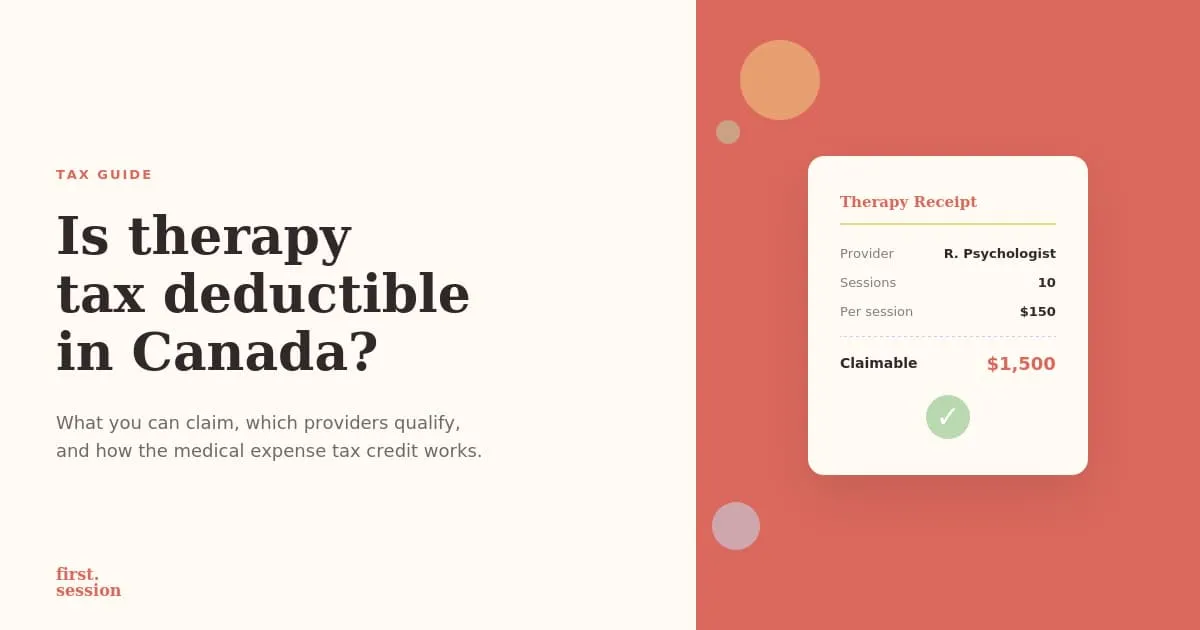
Assume someone attends 10 therapy sessions at $150 each. Total cost: $1,500. Assume the therapist is eligible under CRA rules in that province and assume there was no insurance reimbursement.
Example 1: net income of $60,000
Three percent of $60,000 is $1,800. Since the CRA threshold is the lesser of 3% of net income or $2,834, the threshold here is $1,800. If total therapy spending is $1,500, the expenses do not rise above the threshold. In that scenario, therapy by itself would usually produce little or no federal medical expense tax credit.
Example 2: net income of $30,000
Three percent of $30,000 is $900. If total therapy spending is $1,500, the amount above the threshold is $600. The federal credit is based on that eligible amount. Using the 15% federal rate, the federal portion would be about $90, with a provincial or territorial credit potentially adding more depending on where the person lives.
Is it worth the time?
For many people, the answer is yes, especially when therapy is combined with other eligible medical expenses in the same 12-month claim period. The value becomes more noticeable when income is lower, total medical spending is higher, or several family members' eligible expenses are grouped efficiently.
Bottom line
Therapy can qualify for tax relief in Canada when it is provided by a licensed professional whose designation is recognized by the CRA in the province or territory where they practise. For First Session readers, the main designations to focus on are psychologists, registered social workers where recognized, registered psychotherapists where recognized, and counselling therapists where recognized.
For titles such as Registered Therapeutic Counsellor, Registered Professional Counsellor, and Canadian Certified Counsellor, the safest framing is careful and specific. Those titles do not appear by name on the CRA's current authorized-practitioner page, so eligibility depends on whether the provider also falls within a recognized regulated category in that jurisdiction.
Use First Session to find the right therapist for you.
Frequently Asked Questions
Yes, therapy can qualify for tax relief in Canada when the service is provided by a licensed professional recognized by the CRA in your province or territory. For most people, the claim is made through the medical expense tax credit on a personal tax return.
Counselling can be claimable in Canada when the provider’s designation is recognized by the CRA for medical expense tax credit purposes in that province or territory. Eligibility depends on the practitioner’s regulated title and licensing status.
In many cases, yes. Psychologists are recognized by the CRA across Canada for medical expense tax credit purposes, so fees paid to a licensed psychologist are often claimable when you have proper receipts and the expense was not reimbursed.
Often, yes. Registered social workers are recognized by the CRA in many provinces. The exact answer depends on the province or territory where the therapist is authorized to practise and whether the receipt meets CRA requirements.
They can, depending on the province. The CRA recognizes psychotherapist-related categories in certain jurisdictions, so the provider’s exact designation and location both matter when determining whether therapy fees are claimable.
Yes. You should keep receipts that show the client name, provider name, provider designation, date, amount paid, and description of the service. You should also keep records showing any insurance reimbursement, since only unreimbursed amounts are generally claimable.
It depends on your income, your total eligible medical expenses, and whether your therapy costs exceed the CRA threshold used for the medical expense tax credit. Therapy can produce meaningful savings, especially when combined with other eligible medical expenses in the same claim period.

First Session Editorial Team
The First Session Editorial Team, composed of seasoned researchers, writers, editors, and therapists, focuses on providing content that helps Canadians find the right therapist.
