-Cropped.webp)
Tanasha Wilkinson
Registered Social Worker
- $180/session
- In Person Sessions in Brampton, ON
- Virtual Sessions in Ontario
Meet Tanasha
My experiences and interests give me a unique understanding of…
How to bring both professional training and lived experience into the therapy space in a grounded, ethical way.
The long and often nonlinear process of healing from trauma, including surviving abuse and rebuilding a relationship with oneself over time.
The importance of honoring the pace and individuality of healing, shaped by firsthand knowledge that insight alone is not enough—lasting change comes from consistent, intentional work.
The power of personal stories, and what it means to carry experiences that are invisible to others while continuing to show up for family, work, and community.
The value of accountability, structure, and tradition in healing, alongside emotional depth and self-compassion.
The complex impacts of trauma, chronic stress, relational wounds, and identity-based pressures on both adults and youth.
The experiences of those who had to grow up quickly, learned survival before safety, and are now ready to move from endurance into intention.
Healing as a process that unfolds not through shortcuts, but through honest work, steady support, and the courage to face oneself with clarity and care.
My cultural or ancestral background is…
Shaped by Black Caribbean descent and the intergenerational resilience that comes with it.
Informed by an awareness of how history, culture, and systemic realities influence identity, family roles, and mental health.
Attuned to the impacts of racialized stress, expectations of strength, migration narratives, and the unspoken pressures often placed on Caribbean and Black families.
Approached with respect rather than assumption, honoring cultural values, traditions, and collective responsibility.
Grounded in a commitment to gently challenging patterns that no longer serve healing, while preserving what offers meaning and strength.
Understood as an anchor—supporting the work of healing as clients move forward with intention, clarity, and self-trust.
My clients describe me using words like…
Grounded, compassionate, transparent, direct, and consistent.
Safe but not permissive.
Calm, steady, and reassuring.
Warm yet structured.
Encouraging and steady.
Respectful and attuned.
Expertise
Areas of Focus
Specializations
- Abuse (Sexual/Physical/Verbal)
- Childhood trauma
- Trauma
By category
- Abuse (Sexual/Physical/Verbal)
- Childhood trauma
- Complex Trauma (CPTSD)
- Domestic violence
- Intergenerational trauma
- Trauma
My clients often self-identify as…
Individuals navigating the lasting impact of trauma, chronic stress, or relational wounds.
People who have spent years being strong for others, including caregivers, parents, professionals, or youth who learned early how to survive rather than feel.
Individuals seeking clarity and stability, along with a deeper understanding of themselves and their internal world.
Those experiencing identity shifts, boundary challenges, and people-pleasing patterns.
Individuals carrying the weight of unprocessed experiences, now ready to move from coping toward intentional, sustainable healing.
I’m the right therapist for you if…
You are ready to do honest work that is not rushed, not performative, but real.
You are willing to examine patterns that no longer serve you and take responsibility for your healing, even when the process feels uncomfortable.
You value structure, consistency, and transparency in the therapeutic relationship.
You want a space that balances compassion with accountability, offering support while still encouraging growth.
You are tired of surviving and ready to build a grounded, intentional relationship with yourself.
You are seeking clarity, self-respect, and sustainable change, rather than quick fixes or surface-level relief.
Therapeutic Frameworks & Approach
- Cognitive Behavioural Therapy (CBT)
- Emotion-Focused Family Therapy (EFFT)
- Eye Movement Desensitization and Reprocessing (EMDR)
- Guided Imagery
- Inner Child Work
- Trauma-Informed
If we work together you can expect to feel…
Supported, seen, and appropriately challenged within a space that is held with care.
More grounded and clear in your thinking, with steadier emotional responses over time.
Purposeful discomfort at times, as old patterns are examined in a way that is thoughtful and contained.
More connected to yourself, with increased confidence in your decisions.
More capable of setting and maintaining healthy boundaries in your relationships and daily life.
A growing sense of stability, self-trust, and intention, rather than pressure to be perfect or constantly at ease.
Populations Served
- Teens (13-17)
- Adults (18+)
- Adults (25+)
- Seniors (65+)
Practice Details
Service Offerings & Rates
- Initial ConsultationFree
- Individual Session$180
- Couples Session$290
During your free consultation, we’ll go over…
What brings you to therapy at this point in your life and what you’re hoping to gain from the process.
Whether my approach is the right fit for your needs, goals, and expectations.
Relevant background information, current stressors, and any previous experiences with therapy that may shape your perspective.
Logistics such as confidentiality, session structure, and next steps in the process.
Your questions and reflections, allowing space to get a felt sense of how it might be to work together.
Clarity without pressure, so you can decide how to move forward with intention and confidence.
If we work together you can expect me to…
Show up consistently, transparently, and with intention in our work together.
Listen carefully and ask thoughtful questions, offering honest reflections that bring patterns into focus without judgment or avoidance.
Balance compassion with accountability, supporting you while still encouraging responsibility and growth.
Respect your pace while gently promoting forward movement.
Hold a structured and grounded space where your experiences are taken seriously.
Honor your boundaries and keep the work focused on meaningful, sustainable change.
Insurance & Benefits Coverage
Coverage depends on the insurance plan. Check with your insurance provider to see if your plan covers one of the listed designations.
- Registered Social Worker
For insurance purposes, this therapist’s home province is Ontario.
In Person Sessions
In Person Location
350 Rutherford Rd. South Plaza 2, Unit 104, Brampton, ON, L6W 4N6, Canada
Virtual Sessions
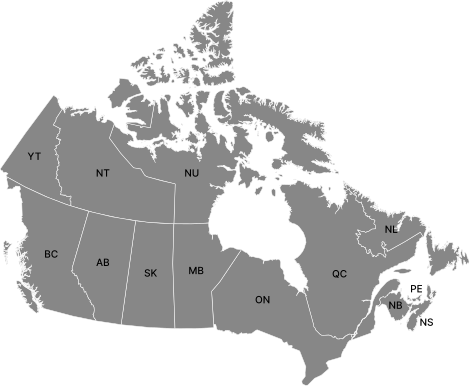

Eligible provinces and territories are highlighted in green.
- Ontario
More Info
Education
Walden University
Masters of Social Work · 2023
University of Manitoba
Bachelors of Social · 2019
Certifications
EMDR Training · 2021
Core Emotion Forced Family Therapy · 2023
Therapeutic Success Strategies for Borderline, Narcissistic & Antisocial Disorders · 2024
Languages
English
Booking FAQ
Does Tanasha offer direct billing with my insurance? Or how does payment work?
First Session charges each session directly to your credit card. Once each session occurs and your card is charged, you’ll receive a PDF receipt by email with all the details you need to get reimbursed (therapist name, designation, license number, address, etc.). You can then submit the receipt to your insurance company for reimbursement if you have coverage. We always recommend checking your coverage with your provider before booking.
How do I know if Tanasha is a good fit?
You are the expert when it comes to knowing who’s the right fit. Watch the therapist’s video at the top of their profile and see whether the message and energy resonate. If you feel drawn to speak with them, listen to your gut — booking a free consultation is a great first step to assess fit.
What if I see no available times to book a session?
If the therapist is listed as accepting clients and you see no available times, it’s likely they haven’t updated their availability (sorry about that!). In this case, you can to see what times they have available.
Can I contact Tanasha before booking an appointment?
If you still have questions before booking that can’t be answered during your free consultation, you can .
Book with Tanasha
View Tanasha’s availability and book a session in just a few clicks.