.webp)
Emily Hiram
Registered Psychotherapist
- She/her
- $170/session
- Virtual Sessions in Ontario
Meet Emily
My experiences and interests give me a unique understanding of…
Living in a body in a culture that constantly tells us it should be different. My own history of navigating body image struggles and complicated relationships with food informs the compassion and depth I bring to this work.
The emotional and logistical complexity of moving a family internationally — relocating to London, England and then returning home — and how identity, belonging, and partnership can shift during major life transitions.
Reinventing yourself professionally. As someone who transitioned from corporate HR into psychotherapy as a second career, I understand the courage, uncertainty, and identity shifts that can come with starting over.
The experience of appearing high-functioning and capable while struggling internally.
The pressure many women feel to hold everything together — and the invisible mental load that often comes with that.
How intergenerational patterns, achievement-driven environments, and cultural expectations shape our relationship with self-worth.
Parenting neurodivergent children — including the advocacy, exhaustion, fierce love, grief, pride, and constant recalibration that can come with raising kids whose brains work differently.
The ways stories — the ones we inherit, the ones we tell ourselves, and even the ones we read — influence identity and resilience. My love of travel and literature continues to deepen my curiosity about people and perspective.
My clients describe me using words like…
Warm and calm
Thoughtful
Insightful and attuned
Gently challenging
Compassionate
Easy to talk to
Grounded
Expertise
Areas of Focus
Specializations
- Negative body image
- Chronic Dieting
- Maternal mental health
By category
- Anxiety
- Anger
- Dreams
- Coping Skills
- Parts Work
- Negative thinking and ruminating
My clients often self-identify as…
The “strong one”.
The responsible one.
The one who keeps it together.
The one who looks fine — but doesn’t feel fine.
The one who thinks about food and their body more than they’d like to admit.
Adult children of emotionally immature or narcissistic parents.
The one who turns to food for comfort — and then feels ashamed for it.
The one who is tired of fighting themselves.
I’m the right therapist for you if…
You look like you’re holding it all together on the outside, but inside you feel anxious, overwhelmed, or stuck.
You’re tired of fighting your body or obsessing about food and want a more peaceful relationship with both.
You’re a caregiver, parent (including of neurodivergent kids), or helping professional who rarely puts yourself first.
You’ve gone through a major life transition — motherhood, relocation, career change — and don’t quite recognize yourself anymore.
You want to understand the deeper roots of your patterns, not just learn coping strategies.
You’re curious about how your past and your “parts” may be influencing your present.
You want therapy that feels thoughtful, compassionate, and gently challenging.
Therapeutic Frameworks & Approach
- Internal Family Systems (IFS)
- Psychodynamic Therapy
- Depth Psychotherapy
- Humanistic Therapy
- Transpersonal Therapy
- Existential Therapy
- Anti-Opressive Practice
- Body-oriented Psychotherapy
- Compassion-Based Approach
- Culturally Sensitive Therapy
- Health at Every Size (HAES)
- Integrative Psychotherapy
- Parts Work
- Sensorimotor Psychotherapy
- Trauma-Informed
If we work together you can expect to feel…
A deeper understanding of why you think, feel, and respond the way you do.
A recognition of patterns that once protected you but may no longer be serving you.
More self-acceptance and a softening of harsh self-criticism.
Less driven by anxiety, shame, or perfectionism.
Stronger in your ability to respond thoughtfully rather than react automatically.
A more peaceful relationship with food, your body, and yourself.
Greater emotional steadiness and clarity in your relationships.
An ability to make choices that reflect your values rather than your fears.
Populations Served
- Seniors (65+)
- Adults (18+)
Practice Details
Service Offerings & Rates
- Initial ConsultationFree
- Individual Session$170Sliding scale offered on case by case basis
Insurance & Benefits Coverage
Coverage depends on the insurance plan. Check with your insurance provider to see if your plan covers one of the listed designations.
- Registered Psychotherapist
For insurance purposes, this therapist’s home province is Ontario.
Virtual Sessions
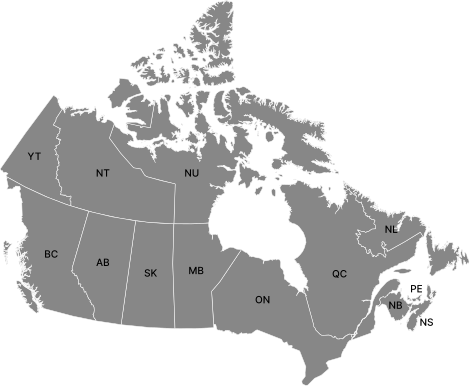

Eligible provinces and territories are highlighted in green.
- Ontario
More Info
Education
The Living Institute
Diploma in Existential Integrative Psychotherapy · 2018
The University of Waterloo
Bachelor of Mathematics, Honours Co-op, Economics Option · 2004
Certifications
IFS Introductory Course · 2025
IFS Connect
PESI
Binge Eating and Chronic Dieting Professional Course · 2024
Perinatal Mood & Anxiety Disorder (PMAD) Certificate · 2021
Postpartum Support International
Sensorimotor Psychotherapy Institute
Level I: Sensorimotor Psychotherapy for the Treatment of Trauma · 2017
200 hour teaching training program · 2011
Ahimisa Yoga and Radiant Living
Languages
English
Booking FAQ
Does Emily offer direct billing with my insurance? Or how does payment work?
First Session charges each session directly to your credit card. Once each session occurs and your card is charged, you’ll receive a PDF receipt by email with all the details you need to get reimbursed (therapist name, designation, license number, address, etc.). You can then submit the receipt to your insurance company for reimbursement if you have coverage. We always recommend checking your coverage with your provider before booking.
How do I know if Emily is a good fit?
You are the expert when it comes to knowing who’s the right fit. Watch the therapist’s video at the top of their profile and see whether the message and energy resonate. If you feel drawn to speak with them, listen to your gut — booking a free consultation is a great first step to assess fit.
What if I see no available times to book a session?
If the therapist is listed as accepting clients and you see no available times, it’s likely they haven’t updated their availability (sorry about that!). In this case, you can to see what times they have available.
Can I contact Emily before booking an appointment?
If you still have questions before booking that can’t be answered during your free consultation, you can .
Book with Emily
View Emily’s availability and book a session in just a few clicks.